Japan Train Etiquette: The Rules Nobody Tells You
Japan's trains are famously punctual, clean, and quiet. They stay that way because almost everyone follows the same unwritten rules. Here is what they are.
1. Get an IC card first
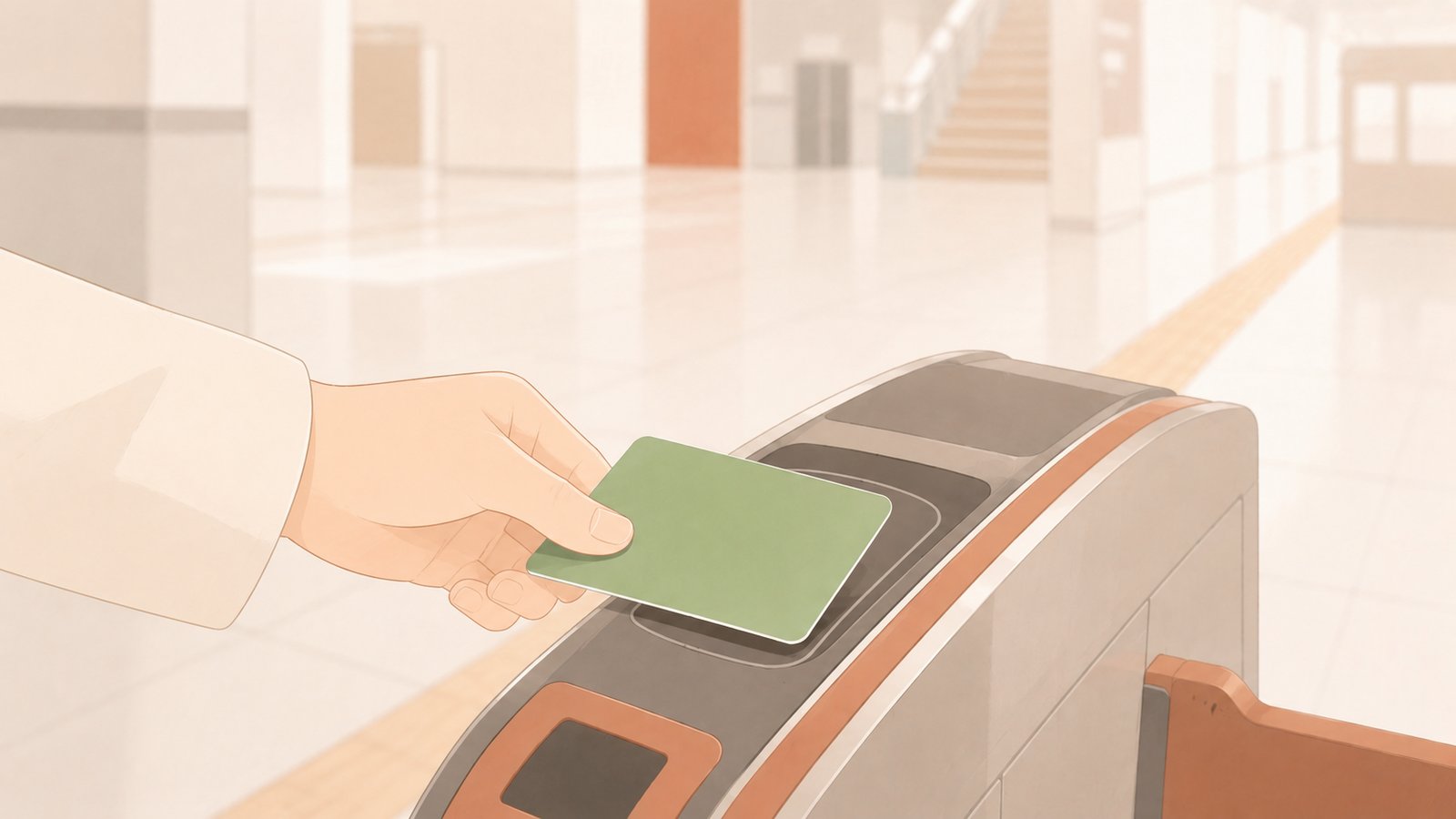
Suica (JR East) and PASMO (Tokyo private lines) are rechargeable cards that work on nearly every train, subway, and bus in Japan, plus convenience stores and vending machines. Other regions have their own cards (ICOCA in Kansai, etc.), but they are all interchangeable.
- iPhone users: add Suica in Apple Wallet, or use JR East's Welcome Suica Mobile app (tourist version, valid 180 days, no deposit, can also book Shinkansen seats). Either works before you land, and both top up with a foreign credit card.
- Android users (non-Japanese phones): you will need a physical card. Look for the Welcome Suica (JR East) or Tourist PASMO at airport stations — both are deposit-free and valid for 28 days. Unused balance is not refunded, so keep top-ups small near the end of your trip.
- Staying longer than 28 days? A regular Suica or PASMO (¥500 refundable deposit) is sold again at station machines.
Tap in at the gate, tap out at your destination. The fare is calculated automatically.
2. Queue at the marked lines
Platforms have painted markings showing where the doors will open. Line up behind them, on either side, and let passengers get off before you board. Do not stand in front of the doors.
3. Priority seats
Every car has priority seats, usually at the ends, marked with a different color and pictograms. They are for elderly passengers, pregnant women, people with disabilities, and people with small children.
You can sit there if they are empty, but be ready to stand up immediately when someone who needs it boards. Near priority seats, put your phone in silent mode and avoid calls.
4. Phones: silent, and no calls
- Set your phone to silent mode ("manner mode" in Japanese).
- Do not take phone calls on trains. If you must, keep it to a whisper and end it quickly — or get off at the next station.
- Texting, browsing, and gaming are fine.
5. Talking and noise
Quiet conversation is fine. Loud groups are not. Keep headphone volume low enough that the person next to you cannot hear it.
6. Eating and drinking
- Local trains and subways: no eating. A sip of water or a closed drink is acceptable.
- Shinkansen and limited express trains: eating is expected. Buying an ekiben (station lunchbox) for the bullet train is part of the experience.
7. Backpacks and luggage
In crowded cars, take your backpack off and hold it in front of you or put it on the rack above the seats. Large suitcases go in the space behind the last row of seats or in the vestibule. On the Shinkansen, oversized luggage (over 160 cm total dimensions) requires a seat reservation with a luggage space.
8. Rush hour
Tokyo rush hour is roughly 7:30–9:00 and 17:30–19:30 on weekdays. If you have luggage or are not in a hurry, avoid it. Some lines have women-only cars during morning rush hour, marked in pink on the platform.
9. Escalators
Stand on the left in Tokyo and most of Japan, on the right in Osaka. Officially, railway companies now ask everyone to stand still on both sides, but local habits persist.
10. When you miss your stop
Just get off at the next station and cross the platform. No penalty, no extra fare — the IC card charges by origin and destination only.
Quick checklist
| Do | Don't |
|---|---|
| Use an IC card | Take phone calls |
| Line up at the door markings | Eat on local trains |
| Hold your backpack in front | Block the doors |
| Keep your voice down | Sit in priority seats when someone needs them |
Turn this into a route you can follow
tabilogue lets you save spots in order and follow other travelers' routes on a map — so you know exactly where to go next. Ready to book? Klook has tickets, tours and transfers across Japan.
The Klook link above is an affiliate link.