Temple and Shrine Etiquette in Japan
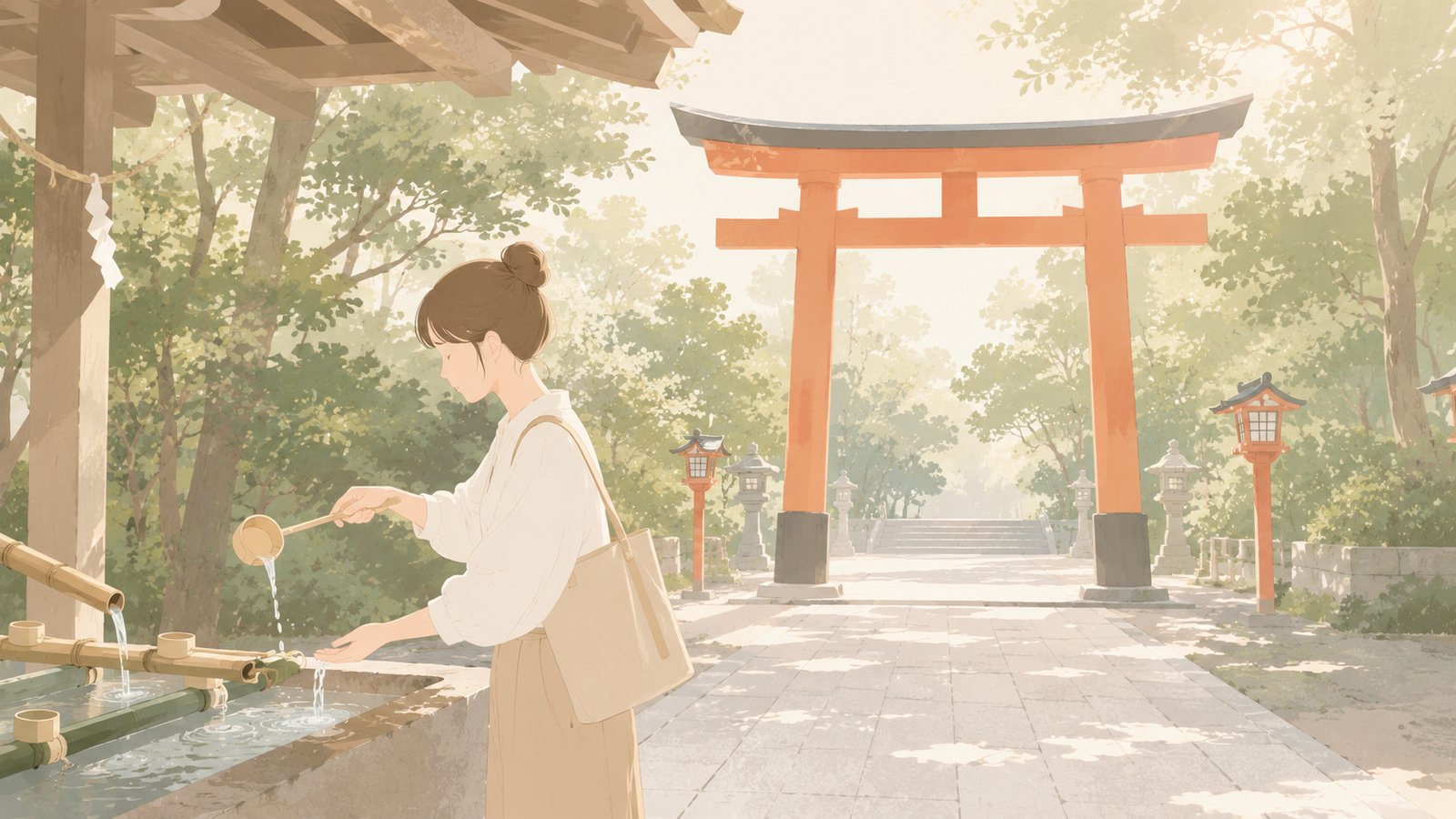
Shrines and temples are open to everyone, and nobody expects visitors to know every custom. But following the basic steps shows respect — and makes the visit more interesting.
Shrine or temple? How to tell
| Shrine (jinja) | Temple (tera / -ji) | |
|---|---|---|
| Religion | Shinto | Buddhism |
| Entrance | Torii gate (usually vermilion) | Large wooden gate, often with guardian statues |
| Inside | Sacred ropes, paper streamers, fox or dog statues | Buddha statues, incense, a bell |
| Praying | Bow, clap twice, bow | Bow quietly, palms together, no clapping |
Many famous sites in Kyoto and Nara are temples (Kiyomizu-dera, Todai-ji, Kinkaku-ji). Fushimi Inari and Meiji Jingu are shrines.
Visiting a shrine
1. The torii gate
Bow lightly before passing through. Walk along the side of the path, not the center — the center is considered the path of the deity.
2. Purify at the water basin (temizuya)
- Take the ladle in your right hand and rinse your left hand.
- Switch hands and rinse your right hand.
- Pour water into your left hand and rinse your mouth (do not touch the ladle to your lips). Spit discreetly beside the basin, not back in.
- Rinse your left hand again.
- Tip the ladle upright so the remaining water runs down the handle, then replace it.
Use one scoop of water for all steps.
3. Pray at the main hall
- Toss a coin into the offering box. A 5-yen coin is traditional (go-en sounds like "good fortune"), but any amount is fine.
- If there is a bell, ring it once or twice.
- Bow twice, clap twice, pray silently, bow once.
Visiting a temple
- Bow at the gate.
- Purify at the basin if there is one (same steps as above).
- If there is an incense burner, you may buy a bundle of incense, light it, and wave the smoke toward yourself — it is said to have healing properties.
- At the main hall: toss a coin, put your palms together, bow, and pray silently. Do not clap.
Omikuji (paper fortunes)
Usually ¥100–300. Draw a numbered stick or open a drawer, and read your fortune. Rankings from best to worst:
- Daikichi — great blessing
- Kichi — blessing
- Chukichi / Shokichi — middle / small blessing
- Kyo — bad luck
If it is bad, tie it to the designated rack or tree so the shrine keeps the bad luck. If it is good, you may take it home. Many popular shrines now offer English versions.
Ema, omamori, and goshuin
- Ema (wooden plaques): write a wish and hang it up. Tourists are welcome to do this.
- Omamori (amulets): sold for specific purposes — safe travel, exams, health. Do not open them.
- Goshuin (calligraphy stamps): a beautiful souvenir, written by hand into a dedicated book (goshuincho). Buy the book at the first temple you visit; it costs about ¥1,500–2,500, and each stamp is ¥300–500.
Photography
- Photos of buildings, gardens, and gates are generally fine.
- Check for signs at the main hall — interiors and statues are often off-limits.
- Do not photograph people praying, and do not photograph shrine staff or monks without asking.
- Never climb on fences, statues, or torii for a shot.
Dress and behavior
- No dress code, but avoid anything you would not wear to a quiet public building.
- Keep your voice down, especially at temples.
- Do not eat or smoke on the grounds.
- Remove your hat inside halls.
Quick checklist
| Do | Don't |
|---|---|
| Bow at the gate | Walk down the center of the path |
| Purify hands before praying | Drink from the ladle |
| Clap at shrines only | Clap at temples |
| Tie bad omikuji at the shrine | Photograph interiors where prohibited |
Turn this into a route you can follow
tabilogue lets you save spots in order and follow other travelers' routes on a map — so you know exactly where to go next. Ready to book? Klook has tickets, tours and transfers across Japan.
The Klook link above is an affiliate link.